


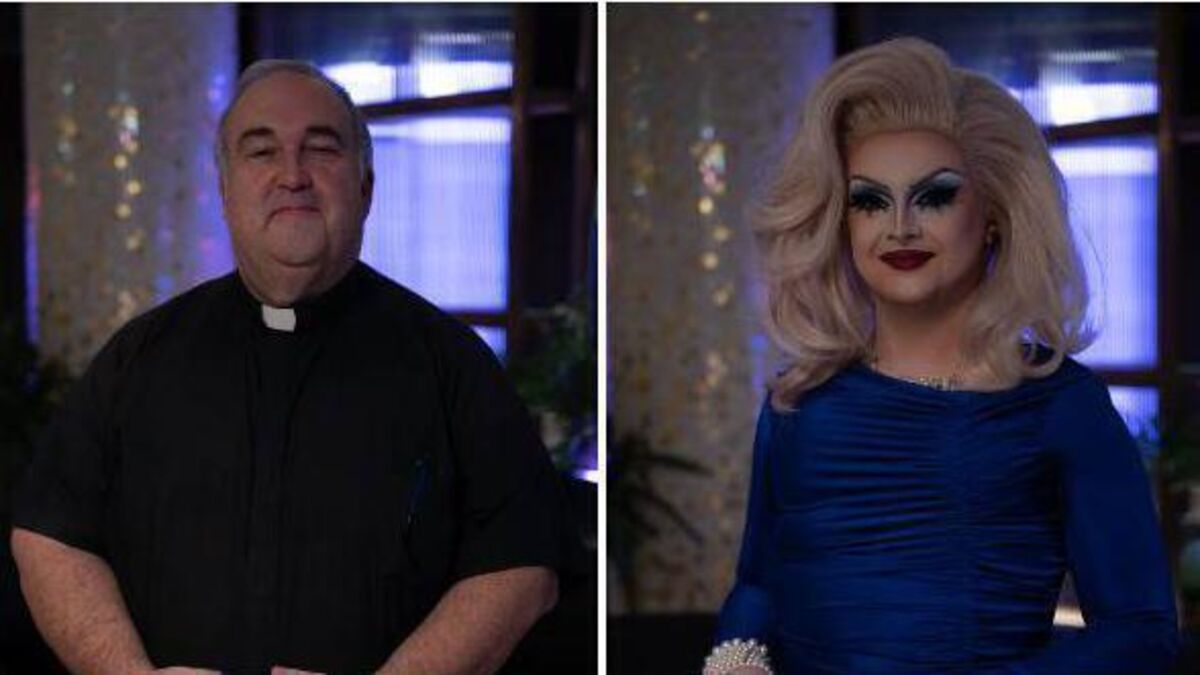
A drag queen and a priest walk into a bar…it sounds like the set-up for an off-colour joke but it is in fact the premise for an intriguing new television show which looks at how the art of conversation and debate is under threat as more of us seek connection in online bubbles.
In the Virgin One series Eating with the Enemy, two strangers with opposing views and opinions sit down for a meal together to see whether they can find any common ground.
Each episode features four sets of people who have been paired by their differences, and the conversation is steered by a menu of questions which pop up on their screens.
“We wanted to take people out of their echo chambers to meet the kind of person they would never have met before, and steer the conversation into areas where it might not normally go, to robustly discuss the topics they disagreed on but also to find something in common,” says Jean Devlin of Animo Television, the production company behind the show.
Participants were selected through a call-out via social media and the producers also contacted various organisations seeking out suitable opinionated candidates. In the first episode, this includes the aforementioned drag queen and make-up artist Bonnie, and Catholic priest Joe; Trump supporter Luke breaking bread with Nigerian-Irish law lecturer Bashir; and libertarian Adam meeting up with political opposite, Mattress Mick.
Devlin says it was fascinating to observe how the simple act of sitting down with each other engendered a respect that is often lacking in faceless social media interactions.
“Even by virtue of sitting down across from each other at the table, everybody’s first instinct was to make the other person feel comfortable,” she says.
All participants had a session with one of the show’s psychologists, Malie Coyne, beforehand, to ensure they were up to the experience. With live tweeting a common feature of the way we watch television now, Devlin says producers are very aware of the impact of hurtful comments about participants on social media.
“Duty of care is hugely important and it is something we obviously take really seriously. It is so integral to making television now, because it is more of an interactive experience.”
Given the subject matter, the series is sure to provoke a big reaction among viewers, who will surely marvel at the restraint shown by Becca when her dining companion and beauty pageant judge Michael proclaims of the infamous serial killer: “Ted Bundy — I love him, he’s a legend”.
The show was filmed last November under strict Covid protocols at the Chancery Grill in the Radisson Hotel, Dublin, with each participant seated at either end of a long table and with no other guests in the restaurant. While things may have got heated in terms of conversation, they never bubbled over into anything nasty, says Devlin.
“We didn’t have any situations where people got upset or aggressive, obviously we would have stepped in if there had been any sense of intimidation. That is a testament to how, when you take people off social media and the horrible interactions that can happen when people are behind a keyboard, people are inherently decent. When they meet face-to-face, they have a tendency to get on with each other.”
This is a view echoed by Cork-born psychotherapist Richard Hogan, who contributes to the show. He says he sees the results of increasing polarisation due to social media on a daily basis in his work, that difference in opinion is no longer tolerated, leading to a decrease in meaningful interaction.
“I work in schools and universities and I see how a lot of kids are not able to have discourse and they find difference so troubling. A lot of them find it hard to find a conversation where their ideas are challenged. We are being limited in our interactions with each other, for a lot of reasons but a huge one is that we don’t want to have an argument or hear different opinions.”
Hogan and his colleague Malie Coyne helped design the questions that prompt discussion between the participants and also provide on-screen analysis of what is going on in the conversations, as well as giving tips on how to improve communication and discourse.
“Malie and I were brought in to make sure the conversations were well-managed, that people didn’t feel unsafe, that was a really important part of it. When I was asked to contribute to the show, I said I wouldn’t do it if it was like Jeremy Kyle — people just shouting their points of view at each other. That is the antithesis of what I wanted to be involved in. I like the concept of how do we achieve a civilised discourse, talk to each other, and manage difference? That is what makes a healthy family and society.”
One of the highlights of the show’s first episode is the conversation between drag queen Bonnie and priest Joe, where appearances prove to be deceptive.
“That was super. For me, that conversation exemplified what the show is designed to be about. When would those two people sit down and have a conversation? Never. And in the other conversations, even though there was difference, there was also incredible respect and dignity.” Ultimately, Hogan says he hopes the show demonstrates how we need to accommodate difference.
“We shouldn’t be seeking out the echo chambers — when we limit our interactions to people who echo our thoughts and feelings, we are actually diminishing our experience of the world. We should always be open to hearing new ideas. The algorithms feed into your preferences and give you more of the same and that creates polarisation.
“We saw the terrifying conclusion of that in America, how one viewpoint gets out there, and the next thing they are storming Capitol Hill and five people are dead. The show is pushing back against that — difference isn’t a bad thing and you should be able to hear it in a respectful way, and have a discussion with someone who doesn’t agree with you.”
Some of the topics that will be discussed in other episodes include plastic surgery, polyamory and social influencers — and a young female dairy farmer dining with a lifelong vegan. Devlin says they are hoping the show will also provoke discussions among viewers at home.
“Hopefully it will promote debate at home around some of the issues, especially that the sense of other and otherness is a construct….we all stick with like-minded people, we are all guilty of that to an extent. You do need to open yourself up to people of different backgrounds and with different points of view,” she says.
This seems to be a message that was taken on board by some of the participants.
“Nobody came away thinking ‘I never want to see that person again’ — a lot of people actually exchanged numbers, which I thought was interesting.”
- Eating With The Enemy starts on Virgin Media One on Wed, March 3, at 9pm
Credit: Source link


