


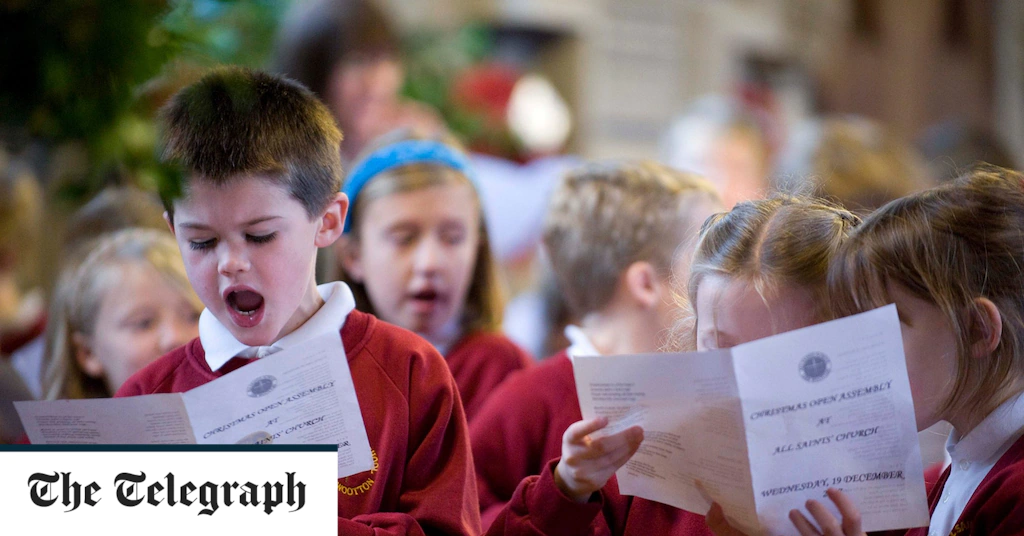
Millions of us who found the Christian story somewhat far-fetched nonetheless went through our educational careers being culturally enhanced by the magnificent tunes that many of our hymns featured. The doctrine, except for the precociously devout, were neither here nor there. One obvious casualty of this bonkers pronouncement will be one of the most ravishing hymn tunes ever written, Repton – recognisable immediately from its opening lines:
Dear Lord and Father of mankind
Forgive our foolish ways!
One can almost hear the squeals of anguish from the Church’s imbeciles-in-chief. Can we really be expected to tolerate being told that some of our ways might be foolish? And even if they were, why would it be God’s place to forgive them?
That magnificent tune comes from Sir Hubert Parry’s oratorio Judith. In these culturally benighted times, when the nearest most children come to being inculcated with an idea of beauty is being force-fed pop music and the inanities of CBeebies, when otherwise would they have a chance not just to hear, but to participate in, the music of a composer so great as Parry? One must also doubt that they are encouraged to sing another of his majestic tunes, Jerusalem – which although not a hymn appears in most hymn books – given the entirely erroneous associations made for it with English nationalism and, therefore, colonialism, fascism, imperialism, white supremacy and all the rest of the largely imaginary components of our growing litany of cultural self-hatred.
It is suggested, instead, that other favourites such as Kumbaya and Lord of the Dance – neither of which one could pretend has the slightest association with a high aesthetic or cultural enrichment – are perfectly safe, because they do not entail undue grovelling to the Almighty for real or imagined wickedness. It does not seem to occur to the those advocating this censorship that few take any notice of the words anyway, and that in life we all have to put up with things – including aspects of the Church of England – that we find tedious or that we disagree with; but that in putting up with them we are provoked to think, mature, and eventually form our own conclusions.
The Church of England has done its best to desecrate – and I choose that verb carefully – its cultural heritage. Worshippers have been driven away by having to endure the Princess Margaret Bible and the Rocky Horror Prayer Book. Organs have been replaced by guitars and tambourines. It is as well the listing of buildings protects most of our churches, because one only has to see the vandalism done inside some of them by what modernising fanatics euphemistically call “re-ordering” to realise the scope such people have to destroy this vital part of our heritage if let loose on it. Think how offensive to parts of the “diverse” community the average church must be – all those crosses, angels, saints in stained glass and the very association of the Gothic style with Christianity.
Taking an important aspect of the Christian religion out of hymns is not only theologically questionable, but it is certainly culturally destructive. Most of our greatest composers, from Tallis and Bach onwards, wrote the hymn tunes that children sing in school assemblies, and most children love singing them. Many tunes sung in the Church of England were pillaged by Vaughan Williams from old secular folk melodies, and recycled for the English Hymnal when he edited it in 1906: they are a vital part of our heritage, brilliantly preserved this way. Will O Little town of Bethlehem, originally a Sussex folk tune, survive the purge? Some extremist on the Church’s provisional wing can no doubt find an anti-diverse reason to hate it and have it banned.
For years it has seemed that the culture of the Church of England as embodied in its buildings, liturgy and music is of far too great national and international significance to be left to the church to superintend. This nonsense about hymn singing finally proves the point.
Credit: Source link


