



 Survivors of atomic bomb pray at Hiroshima's Peace Memorial (ANSA)
 POPE
- Pope Francis
- Japan
- nuclear
- peace
Hiroshima and Nagasaki: 75 anni after the nuclear holocaust Hiroshima and Nagasaki were destroyed by two atomic bombs on 6 and 9 August 1945. Almost a year ago, Pope Francis visited both cities during his Apostolic Journey to Japan.
By Amedeo Lomonaco and Sr Bernadette Reis
It is August 6, 1945. Just a few weeks have gone by since the first nuclear test in history took place on 16 July 1945 in Alamogordo, in New Mexico’s desert. In Europe, the Second World War is already over. Japan, even though it has been isolated, has no intention to surrender. It is 8:15 in the morning when the US Air Force drops a uranium atomic bomb, code-named "Little Boy". Hiroshima, with a population of about 255,000, is hit. An intense heat storm advances at a rate of about 800km/second. At least 70 thousand people are killed instantly. Tens of thousands of others are poisoned by radiation and will die in the days, the months and years ahead.
Read also
24/11/2019
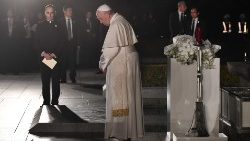
Pope in Hiroshima: Use and possession of atomic energy for war is immoral
A city in ruins
Father Pedro Arrupe (1907 – 1991) was among the eyewitnesses of that tragedy. He would later be elected Superior General of the Society of Jesus, the Jesuits, in 1965. On August 6, 1945 he was in his religious community’s house on the outskirts of Hiroshima. “I was in my room with another priest at 8.15 am, when suddenly we saw a blinding light, like a magnesium glow. As soon as I opened the door that overlooked the city, we heard an incredible explosion similar to hurricane winds. At the same time, doors, windows and walls crashed down in pieces on us. We went up a hill to get a better view. From there we could see a city in ruins. We kept trying to find some way to enter the city, but it was impossible. We then did the only thing that could be done in the presence of such a mass murder: we fell on our knees and prayed for guidance, because we were deprived of all human help."
Between history and memory
In Hiroshima there is a particular place that recalls that August 6. It is the Peace Memorial, a UNESCO World Heritage Center – a building built in 1915 and severely damaged by the 1945 nuclear blast. The ruins of the building and its dome remain permanent warning to humanity, “a stark and powerful symbol of the most destructive force ever created by humankind”, as UNESCO says on its website dedicated to the Hiroshima Peace Memorial, also known as the Genbaku Dome.
In the nearby Museum, through original photographs, realistic models, artistic prints, recovered objects and descriptive explanations, visitors can retrace the history of Hiroshima, before and after the bombing, and the dramatic steps that preceded, accompanied and marked that tragedy.
Read also

24/11/2019
Pope in Japan: Overview of Day Two
Never again the clash of arms
The motto for Pope Francis’s Apostolic Journey to Japan (23-26 November 2019), was “Protect All Life.” That motto sought to bridge 1945 to the present, between the memory of that catastrophe and the threat of nuclear war which still today has not completely been eliminated.
At the Peace Memorial in Hiroshima on 24 November, pronounced these words: “Never again war, never again the clash of arms, never again so much suffering!” A cry lifted up from the place where after “an incandescent burst of lightning and fire” only “shadows and silence” were left behind. “In barely an instant,” the Pope recalled, “everything was devoured by a black hole of destruction and death. From that abyss of silence, we continue even today to hear the cries of those who are no longer. They came from different places, had different names, and some spoke different languages. Yet all were united in the same fate, in a terrifying hour that left its mark forever not only on the history of this country, but on the face of humanity.”
Becoming instruments of reconciliation
During the ceremony at the Peace Memorial in Hiroshima, Pope Francis pointed out three moral imperatives: To remember, to journey together, to protect. It is not permissible that “ present and future generations to lose the memory of what happened here,” he said. “We are called to journey together with a gaze of understanding and forgiveness, to open the horizon to hope,” in order to “become instruments of reconciliation and peace.” This, he added, “will always be possible if we are able to protect one another and realize that we are joined by a common destiny.”
Read also
24/11/2019
The silence of Hiroshima and the cry of the Pope
Importance of remembering
In an interview with Vatican News, Nagasaki Archbishop Joseph Mitsuaki Takami confirms the need to remember what happened. Seventy-five years have gone by and “many Japanese, particularly among young people, do not even know the date of the atomic bomb.” He confirms that may survivors are still alive. Many of them “want to transmit their experiences as survivors to the next generation,” the Archbishop says, and it is being done.
By remembering and transmitting the tragic events that unfolded seventy-five years ago, Archbishop Takami hopes that the world will hear an “appeal about the importance of peace in the world.”
Pope Francis's visit
“The presence and visit of the Holy Father’s very much impressed many, many Catholics and non-Christians also”, the Archbishop says. After the visit, the Japanese Bishop’s Conference issued a questionnaire soliciting feedback about the things that could be done.
Now some projects are being researched and others are in the works, he says. The Bishops also published Japanese translations of all of Pope Francis’s discourses during his Apostolic Journey to Japan.”
This book has an important role, I think”, Archbishop Takami says, “to make known the importance of a non-nuclear world, a world without nuclear weapons.”
Pope Francis-Hiroshima-Meeting for peace 2019-11-24

Your contribution for a great mission:
support us in bringing the Pope's words into every home Topics
- Pope Francis
- Japan
- nuclear
- peace
06 August 2020, 10:41
- Send
