


Although only about 50% of St. Alphonsus students are Catholic, Padrnos pointed out that “catholic” means universal.
“If Catholic education is done, right, it should not be a wall or boundary; it should draw everybody in because it’s for everyone,” he explained. “When you get onto campus or into the school building, my goal is that it should feel like you’re swimming in a Catholic worldview.”
One way Padrnos hopes to instill that worldview is through the school’s “virtue of the month.” Students memorize Scripture relating to that virtue and every week, the school honors students of the week who live out that specific virtue.
“Virtuous living happens every day and we do want to call it out where we see it,” Padrnos said. “The kids need to know that it’s possible — that a life of virtue and holiness can be done, and it should be strived for.”
Padrnos emphasized cultivating the “moral imagination” of students through narrative and play.
“If these students can begin to imagine it, first in story, in the narrative and then really to see themselves as part of a narrative of salvation history that they fit into, imagination then becomes something that’s more real than our day-to-day experience,” he explained. “That’s what we’re trying to give to them, subliminally in a lot of ways, that you’re made for something more. We’re [forming] you to be citizens of this world but ultimately citizens of heaven.”
This year, Padrnos instituted a “house system” where students are sorted into houses named after saints. The “house captains,” who are elected eighth graders, help choose the saints. Throughout the year, the students learn more about their saint, earn points for their house, and join in lighthearted competitions.
“At the start of the year, we did a Harry Potter-style sorting. We found an old hat in the prop room,” Padrnos said. “I got an AI voice generator, typed in like all these little things so that [when] we put the hat on the kid, we’d be in the back and press play on the computer. It’d say [things like] ‘Very interesting… Let me look inside this noggin — ah courage, you must be in the JP2 house!’”
Students earn points for their houses through things like service, altar serving, academic achievements, and practicing virtuous habits.
“It goes to that idea of, ‘I’m not responsible just for myself. I’m responsible for others. My actions have bearing on everyone else,’” Padrnos explained.
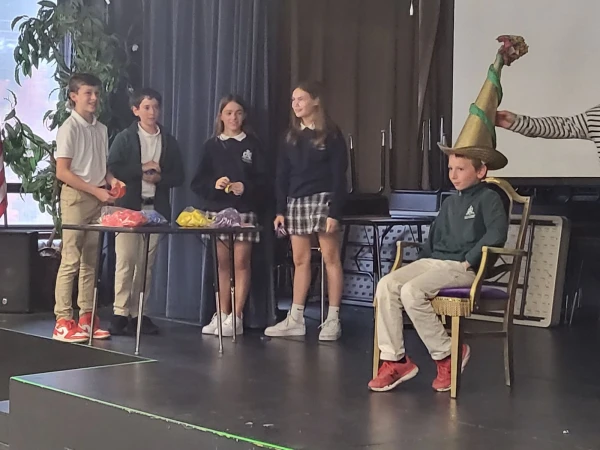
In response to cynicism, Padrnos hopes to instill a sense of play and wonder.
Once a month, St. Al’s has a house challenge where the houses gather in the auditorium and students are randomly selected to play fun games.
“[We do] things like putting shaving cream on teachers’ heads, and kids throw ping pong balls to get them stuck on the teacher’s heads,” Padrnos said. “What does that have to do with the Catholic worldview view? Probably not inherently that much, but again, let’s play into that sense of play, because kids need it.”
“We don’t want the kids to be more mature than they need to be. They’re supposed to be young and there’s something beautiful about keeping that innocence,” he said.
‘The Sacred Heart family’
Another K-8 school taking faith and community seriously is Sacred Heart Catholic School in St. Petersburg, Florida. It also has a “house system” where students and teachers are assigned to groups named after saints. These “houses” each focus on a core value of the school that relates to the saint.
“I’m part of the St. Teresa house,” the school’s principal, Nicole Wilson, told CNA. “So, for example, St. Teresa is ‘serve.’ So my house, our core value that we focus on is ‘serve.’”

Each month, the older students will work on a service project together and the school will tie it to a fruit of the Holy Spirit and a saint that they’re learning about that month. Eighth graders will also pick a charity to help each month.
“We try to do different service projects throughout the school year that are meaningful to the kids,” Wilson explained. “In December, we did Toys for Tots to tie it to Christmas.”
“We like to say that we don’t just have religion class, because it interweaves itself throughout the day,” she said.
When asked what makes Sacred Heart unique, Wilson noted that 90% of the student body (about 226 students) is Hispanic.
“So we have a really big, diverse Hispanic culture that spans through lots of different countries, which is really cool,” she said. “And a lot of the families are very proud of where they come from and who they are.”
Because of this, the school started a Hispanic heritage month celebration and hosted a lunch where the families contributed different foods for the kids to try.
“But it was really cool because you got to see the parents. They had set up tables. They brought fun things for the kids to hand out, and you could just tell how proud and excited they were,” she said. “And it was just this feeling of excitement and community and togetherness that it was catching. You couldn’t not be excited about it.”
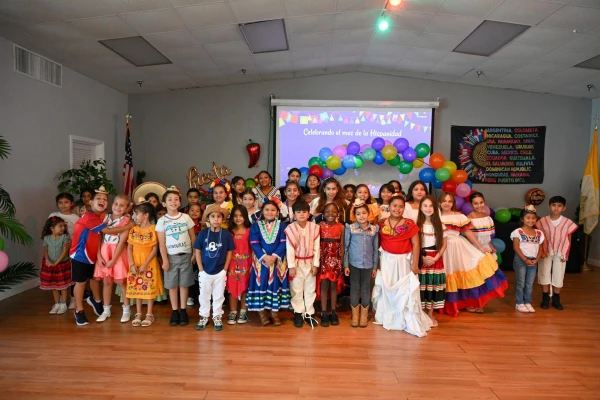
The school has a large number of Catholic families, Wilson noted, but whether you’re Catholic or not, “I have had a lot of people who say that when they walk in the building, it feels like family.”
“I want them to feel welcome, like they’re part [of a community],” she said. “And I always call Sacred Heart ‘our Sacred Heart family.’”
Florida’s school choice scholarship program helps many of the families attend Catholic school, as many are of lower socioeconomic status. This school year, it was no longer income-based.
“When it was income-based, I only had six families that were not on scholarships,” Wilson explained. “So [we] have a very low socioeconomic population.”
“And it’s huge. It really helps a lot of our families who would not normally be able to afford Catholic education to be able to be a part of our school.”
Across state lines
Community is a big part of what headmaster Jay Boren says makes the New England-based school where he works — St. Benedict Classical Academy — unique.
“I think the most remarkable thing about our school is our community, is the people,” Boren explained. “A lot of our parents drive a long way every day to get their children to this particular school for this particular education. A lot of them have moved to this area.”
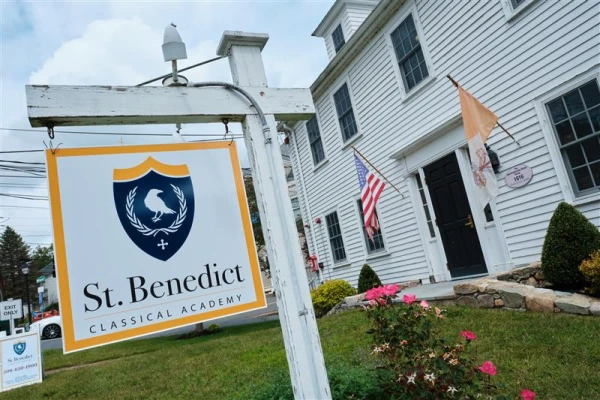
St. Benedict is in Natick, Massachusetts, a suburb of Boston, but the students come from almost 40 towns across two states. Some families make an hourlong commute.
The academy was founded 11 years ago by five moms who wanted a school that was devoted to its Catholic identity with a rigorous academic program. Since then, the school has grown from about 25 students to more than 250 students and broke ground last year for a new campus.
Boren cites two key factors for their success.
“I think it’s twofold: You build a Catholic identity with people, so you have to have a commitment to the mission,” he said. “… We have a commitment to mission, and we’re zero-sum on that. We’re never going to compromise on that. So that is what it is. And then that will attract families who are committed to your mission.”
St. Benedict’s also prioritizes hiring faculty that are “committed to [the] mission.”
“So you have an incredible mission alignment, parent and school, which is really important for the success of the child, the student,” he explained. “We’re seeing a lot of people come to us that probably wouldn’t have come to us five years ago, because they’re becoming dissatisfied with their local public school.”
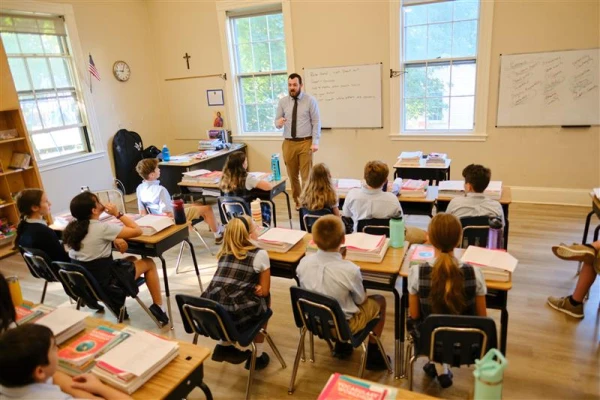
When asked how classical and Catholic education come together at St. Benedict’s, Boren responded: “I would say that for a long time, Catholic education was classical.”
“One of the most important things is how our Catholicism informs the entire curriculum. It’s critical,” he said. “So many times we can see Catholic identity as a cherry on top: ‘We have this really good ice cream and oh, yeah, we have Catholic identity, and we just put it on top.’ And that can’t be the case. It has to inform the entire curriculum.”
Boren explained that the staff prioritizes “secularly virtuous” books and media when arranging the curriculum.
“When we’re thinking about what books we’re going to read in literature class, they’re not religious per se,” he explained. “They’re great works of literature and they’re great works of art and they’re great works of music.”
“Everything that we choose, we choose very deliberately — and they’re beautiful,” Boren explained. “And I think that speaks to the Catholicity of the place. Because that’s what Catholicism uses — the aesthetics — to lift our hearts and minds to God. And I think that’s beautifully interwoven together.”
“If education is a search for truth, well, then it has to end with Jesus Christ, who is truth,” Boren said. “So how that looks in kindergarten versus sixth grade [can] be a little different, but at the end of the day, it has to end there. I think they’re inseparable.”

Kate Quiñones is a staff writer for Catholic News Agency and a fellow of the College Fix. She has been published by the Wall Street Journal, the Denver Catholic Register, and CatholicVote, and she graduated from Hillsdale College. She lives in Colorado with her husband.
Credit: Source link


