


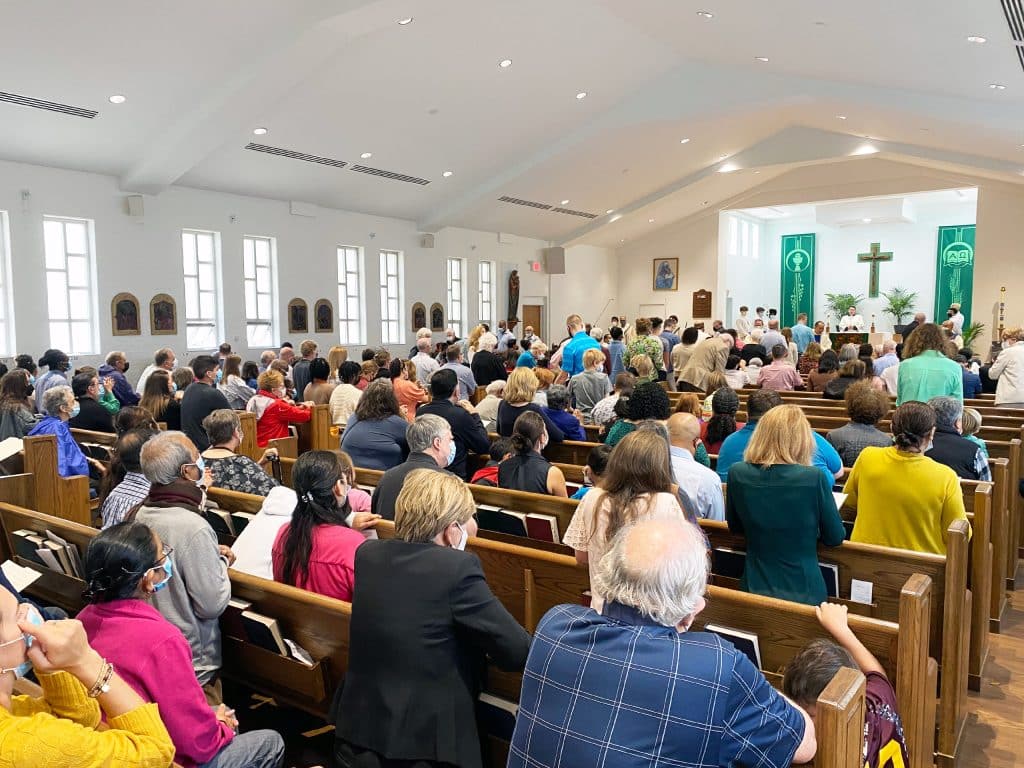
“Beauty, just like truth, always engenders wonder, and when these are referred to the mystery of God, they lead to adoration,” Pope Francis wrote in an apostolic letter last summer “on the liturgical formation of the people of God.”
Titled “Desiderio Desideravi” (“I have earnestly desired”), the letter was released June 29, the feast of Sts. Peter and Paul. The title comes from Luke 22:15 when, before the Last Supper, Jesus tells his disciples, “I have earnestly desired to eat this Passover with you before I suffer.”
The Catholic Herald asked Father Michael D. Weston, diocesan director of divine worship, to reflect on the letter’s primary points. His responses appear below.
Pope Francis issued a document last summer on the celebration of Mass. What did the document say?
The letter is a “meditation” by our Holy Father on the sacred liturgy and a call for a “renewed” church-wide formation in the liturgy. He wrote that he “simply wants to invite the whole church to rediscover, to safeguard and to live the truth and power of the Christian celebration.” The celebration that Pope Francis is speaking about is the Mass and all of the other sacraments.
What is a liturgical formation?
To answer this question, it is important to understand what the definition of formation is and how it applies to the celebration of the liturgy. When we look up the word “formation” in the dictionary, it means “an act of giving form or shape to something or of taking form.” When we think of this definition in light of the liturgy, we have to think of it in a spiritual way. Our mind, attitude and approach are transformed by the inner reality of the sacraments. They are “outward signs, instituted by Christ, to give grace.” What we see on the outside might be bread, wine, water, oil, etc., but the effect they have on us is much deeper. They help us to encounter God and to receive his grace in the spiritual life. They change and form us into who we are more each time we receive them worthily: “Who we are” as children of God. The symbols and the symbolic actions that are part of the celebration of every sacrament, Pope Francis writes, are not abstract concepts but “contain and express the very concreteness they signify.”
Does Pope Francis’ letter change the way the Mass and the other sacraments are celebrated?
Pope Francis’ letter does not change the order or the translation of the prayers of the Mass or any of the sacraments. The Holy Father wants us to better understand the hidden mystery that becomes real in the celebration of every one of the sacraments and to have a better and deeper appreciation of the mystery which, at the core, is the salvific plan of God accomplished through the Paschal Mystery — the Lord’s Passion, death and Resurrection — which we encounter in the sacraments.
How does Pope Francis want liturgical formation to take place within the church?
The Holy Father first encourages the entire church to participate in the “formation” he speaks about in his letter. He says that we are in need of a “serious and dynamic formation” for both the clergy and the lay faithful. It is important to study the liturgy academically, but our study needs to go beyond just “academics.”
We are “formed” by our participation in the liturgy every day. A priest offers Mass every day and through the very act of celebrating the Mass he can be formed by the liturgy itself. As he is faithful to the rubrics of the Roman Missal and to the various rituals he is transformed and sanctified by them. The priest must remember that he is not just performing an action or saying words, the priest must pray the Mass and be attentive to the meaning of the words and the ritual actions and gestures he carries out. These convey to those who are present, including the priest himself, the great mystery that is hidden within them.
The faithful are invited to attend Mass daily and by doing so, they can be immersed as well into the liturgy. This immersion is part of their formation. The lay faithful, for their part, are immersed into the mystery through their full, active and conscious participation. In their posture at Mass, by responding to the greetings of the celebrant or the proclamation of the Word of God, through silent reflection, by listening attentively to the readings and the prayers that are offered, by preparing themselves before and during Mass to receive the body, blood, soul and divinity of the Lord in holy Communion.
What are some of the gestures and postures at Mass?
Some of the gestures include making the Sign of the Cross at the proper times, bowing at the proper point during the Creed on Sundays, a sign of peace during the Communion Rite. The primary postures include standing as we do when the opening procession begins, at the proclamation of the Gospel, during the Preface Dialogue and to receive Communion. Standing is the normative posture for receiving Communion in the United States. We sit during the readings, the homily and the preparation of the offerings. We kneel during the Eucharistic prayer and after the Lamb of God. We can also kneel for our meditation and thanksgiving following Communion. Gestures and postures are an important part of the celebration of the sacraments, especially during Mass. As all in the congregation make the same gestures and keep the same postures, it is a tangible sign of our unity as the body of Christ. They can help to dispose us to what is happening at a specific moment. When we think about them and, more importantly, faithfully follow them we are formed in the celebration of the sacred liturgy by fully and actively participating as we are called.
You said standing to receive Communion is the “normative posture.” In some churches, people kneel to receive Communion, does Pope Francis speak about that in his letter?
Pope Francis does not speak explicitly about the manner of receiving Communion. Receiving Communion whether standing, which is the norm for us in the United States, or kneeling does not make one holier. The same is true for someone who receives Communion in the hand or on the tongue. The church gives each communicant the option of choosing how they wish to receive, on the tongue or in the hand. We may see others choose to receive Communion in a way that is different than the way we do. We are reminded that we are to respect the way other people choose to receive the Lord.
Receiving in the hand or on the tongue or receiving while kneeling or standing is not what makes receiving the Eucharist reverent. Reverence begins with us approaching to receive Communion in the state of grace and disposed to receive the Lord in the Eucharist with the greatest adoration. The Eucharist is the real presence of Almighty God himself. He is fully present — body, blood, soul and divinity — even in the smallest particle of the host and in the smallest drop of the precious blood. We ought never to compare ourselves nor make judgments on the way people receive Communion. The important thing is to remember how we are to receive Communion in a reverent way and with great respect and adoration for the Eucharist.
Credit: Source link


