


Brussels, Belgium, Dec 2, 2025 /
10:08 am
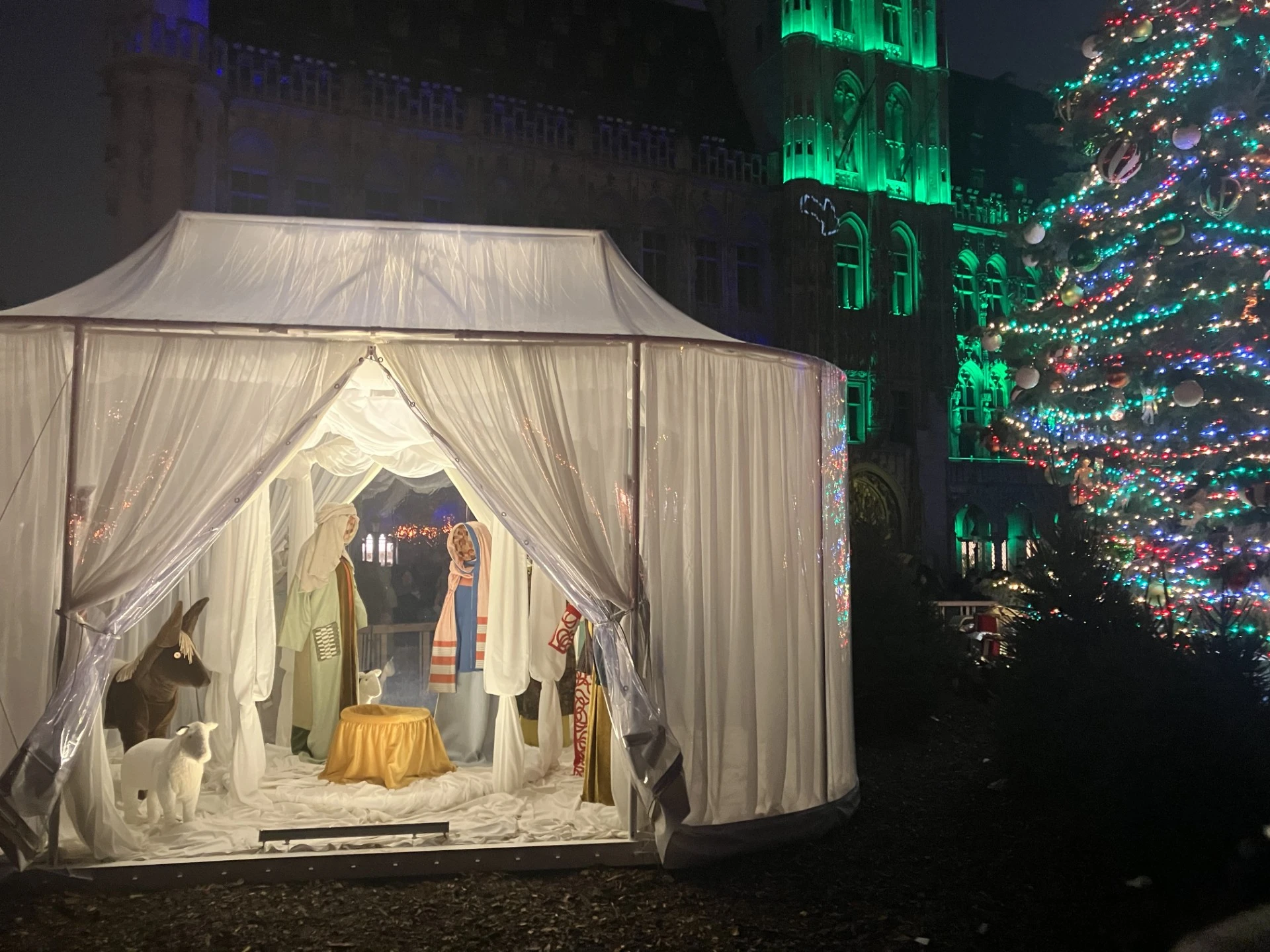
A new Nativity scene featuring faceless cloth figures installed on Brussels’ historic Grand Place — and the theft of the infant Jesus — have ignited fierce debate across Europe, with critics calling it an erasure of Christian tradition and supporters defending it as inclusive art.
The traditional wooden figurines have been replaced with forms made from recycled textiles, with faces consisting only of patchwork fabric in beige and brown tones. Artist Victoria-Maria Geyer crafted the Nativity figures out of cloth with no identifying facial features.
The installation, titled “Fabrics of the Nativity,” was selected through a call for proposals after city officials said the previous wooden Nativity had become too deteriorated to use. The dean of Sts. Michael and Gudula Cathedral was involved in the search for a new project and approved it, according to both municipal and church sources.
The installation drew immediate criticism on social media. Belgian national team soccer player Thomas Meunier triggered widespread reaction on X with his comment: “We’ve hit rock bottom… and we keep digging,” a post that was shared thousands of times.
American conservative author Rod Dreher, who has written extensively about European Christianity, contrasted the Brussels installation with Hungary’s approach. Posting a photo of a traditional wooden Nativity scene outside the Hungarian Parliament, Dreher wrote: “A Nativity scene outside the Hungarian Parliament. A Christian country that is not ashamed of the gift of faith.”
Georges Dallemagne from Brussels’ Christian Democrats party called the missing faces “very shocking,” stating: “The Nativity is a message of universality, not a zombie exhibition.” Liberal party chairman Georges-Louis Bouchez called the installation an “insult to our traditions” and demanded its replacement.
Professor Wouter Duyck of Ghent University suggested political correctness and fear of angering Brussels’ large Muslim population was the real inspiration, noting: “In Islam, the faces of prophets are not depicted.”
Officials defend installation
Brussels Mayor Philippe Close, a Socialist Party member, defended the decision. At a Friday press conference, Close stated: “In this Christmas period, we need to tone it down,” adding that the city wanted to maintain the Nativity tradition while others had removed theirs entirely.
“The old Nativity scene had been in use for 25 years and was showing many defects,” Close said. “It was time to take a new direction. We are very happy with Victoria-Maria’s creation, and we want to make sure the artist is not attacked personally.”
Dean Benoît Lobet of Sts. Michael and Gudula Cathedral also defended the installation, interpreting the crumpled fabrics as symbols of precariousness: “The historical figures in the Nativity were precarious people who were rejected everywhere.”
The controversy intensified over the weekend when the baby Jesus figure’s head was removed, with an unknown perpetrator stealing the cloth head. City officials have replaced the figure and said they will monitor the scene more closely.
International reaction after vandalism
The installation is scheduled to remain on the UNESCO World Heritage site for at least five years. Bouchez’s Liberal party has launched a petition calling for the return of a traditional Nativity scene, stating: “These faceless figures look more like a tribute to the zombies you find around Brussels’ train stations than a Nativity scene.”
The debate has extended beyond Belgium’s borders, with international media framing it as emblematic of broader tensions over European identity and religious heritage in an increasingly diverse continent.

Thomas Philipp Reiter is a Belgian-German journalist based in Brussels, specializing in reporting from Belgium, the Netherlands, and Luxembourg. He studied journalism, economics, and political science in Hamburg, Germany. Since 1986 he has been covering European affairs, authoring books on numerous German and Belgian topics. He is also known as a radio and podcast host.
Credit: Source link


