


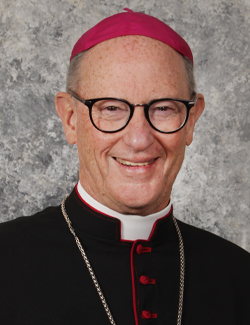
by Bishop James Conley
When I heard the news of the death of Pope Emeritus Benedict XVI, it came as a shock to me. While it is true that, at the age of 95, our beloved Holy Father lived a very long and fruitful life, and it was unexpected that he would live for nearly 10 years after his unprecedented resignation from the papacy in 2013, his death Dec. 31 still came as a shock.
I suppose it is like the death of one’s very elderly grandparent. We all know they are close to the end of their life if they reach their 90s, but it is still a shock when they are gone.
Just knowing that Pope Benedict was living a life of prayer and retirement, in a secluded monastery hidden within the Vatican gardens; it was a consolation and it gave me a feeling of security to know he was there. Now that he has gone to his eternal reward, there is a sense of real loss and emptiness in my heart.
Pope Benedict has always been personal hero and father figure to me. He was the pope who named me a bishop in 2008 when I went to Denver as an auxiliary bishop, and then he appointed me as the Ninth Bishop of the Diocese of Lincoln in 2012. But going back much further, when I was a new Catholic convert in the mid-1970s and then as a young priest in the 80s and 90s, the writings of the then-Cardinal Joseph Ratzinger had a huge impact on my life.
From 1996-2006, I had the honor and privilege of collaborating with him as a Vatican official in the Roman Curia, serving in the Congregation for Bishops. Cardinal Joseph Ratzinger was the Prefect of the Congregation for the Doctrine of the Faith (CDF) and our two congregations would often collaborate on important issues and concerns facing the universal Church at the time.
To be sure, it was the long, 27-year reign of St. John Paul II that really shaped and formed me as a Catholic, a priest, and as a bishop. But Pope Benedict was always there, always present. In many ways, I see St. John Paul II and Pope Benedict XVI as two sides of the same coin. One was a world-class philosopher, the other was one of the greatest theologians of our day. Both lived through the atrocities of World War II as young men. Both were key players at the Second Vatican Council.
And yet, they were very different in temperament and personality. John Paul II was an extrovert, charismatic, and comfortable on the world stage. Benedict XVI was an introvert, shy, and preferred to remain in the background.
As one of St. John Paul II’s closest collaborators for decades, Pope Benedict XVI was very often mischaracterized and cruelly calumniated, as John Paul II’s cold-hearted enforcer of Catholic doctrine. This perception couldn’t be further from the truth. Anyone who had ever met Cardinal Ratzinger during those years when he was the prefect of the CDF, knew him to be a kind, gentle, humble, very serene, calm, mild-tempered and holy man.
Even leading up to his election as Pope Benedict XVI, there was a media storm in opposition to his candidacy. I was actually in my office in the Vatican, which overlooked St. Peter’s Square, on the day when the white smoke went up. I was overwhelmed with gratitude and joy when he walked out onto the loggia for the first time. All of that mischaracterization just melted away when he was elected pope. Even though his naysayers continued to malign him, the real Joseph Ratzinger began to show through from the very beginning. His keen mind and humble heart, coupled with his gentle spirit and unassuming nature, communicated to the world that this was truly a man of God.
His first and, in my opinion, greatest encyclical, Deus Caritas Est (God is Love), really captures the man and his mission. While Pope Benedict XVI was a great defender of the true faith, he knew that truth without love could become cold and impersonal, a harsh list of facts and expectations. By the same token, love without truth can be mere sentimentalism and superficial emotionalism. Caritas in Veritate (Love in Truth) the third in his trilogy of encyclicals (the middle one was on hope), captures Pope Benedict’s vision for our pathway to God, always in pursuit of the true, the good and the beautiful.
Pope Benedict XVI’s legacy, not unlike St. John Paul II, will continue to be unpacked for decades to come. Like his predecessor in the Chair of St. Peter, he holds the key to the authentic interpretation of the Second Vatican Council. St. John Henry Newman wrote that all the ecumenical councils in the history of the Church are like springs that burst out of the ground. They always savor of the soil from which they sprung.
The soil of Vatican II was the 1960s. It takes decades to get downstream from the source of a spring before the water begins to clarify, gather force and provide direction. Those first years after Vatican II were chaotic. There were only a few voices of sanity during those post-conciliar years; Joseph Ratzinger was one of them.
When it came to the Second Vatican Council, Pope Benedict XVI always believed in what he called the “hermeneutic of continuity” and not rupture. In other words, Vatican II was not a break with tradition, but a development, a living spring from that which preceded it. Newman very famously said that “to live is to change, and to be perfect is to have changed often.” But he went on to say that things must change in order to remain the same. And this is what Benedict XVI meant by the “hermeneutic of continuity.”
I am particularly indebted to Benedict XVI for his writings on the sacred liturgy. He believed that the new evangelization could not be successful without a true renewal of liturgical worship. We must all have a keen sense of the supernatural and the transcendent in our lives. We must lift our hearts to the Lord in sacred worship through praise and adoration, in full and active participation with the cosmic liturgy of heaven, if we want our hearts to be transformed in love. We must strive to have a personal encounter with the Lord in the liturgy, in the Mass. When we encounter the living Lord, the only response is praise and song. Pope Benedict XVI knew this well and his writings on the sacred liturgy and his love for the Holy Eucharist will endure well into the future. He will go down in history as a key figure in the authentic reform of the liturgy.
I haven’t even mentioned his contribution as the overseer of development of the Catechism of the Catholic Church and his three-volume masterpiece of scriptural theology and biblical exegesis, Jesus of Nazareth, written in the early years of his pontificate. This has now become the gold standard in biblical interpretation of the life of Jesus. Pope Benedict, an accomplished classical pianist, has been referred to as the “Mozart of theology.” With his facility with languages, both ancient and modern, his broad grasp of history and literature, and his depth of wisdom, he could very well be one of the last truly renaissance men of our age.
While Benedict XVI was arguably the greatest theologian of our age, he was a man who did theology on his knees. He was a man of faith first. Benedict XVI lived out beautifully the medieval definition of theology, coined by the great St. Anselm of Canterbury, Fides quaerens intellectum – faith seeking understanding. Benedict XVI was always a man of deep and abiding faith in loving God. Like the great St. Benedict of Nursia, whose name he took when he was named pope, ora et labora, prayer and work defined his life.
While I will certainly miss this great father figure in my life, who was a holy mentor, an intellectual giant, and a humble successor of St. Peter, my heart sings with deep gratitude for this holy man named Joseph. Like his namesake, he was entrusted with a rich treasure in this life and he was a faithful steward of this mystery to the end.
Credit: Source link


