


Our society values the idea that everything should be okay all the time. From the (false) perfection represented on social media to society’s expectations of conformity; the image of the buttoned-up, well-adjusted, put-together person is an aspirational goal but far from the messy realities of life.
Suffering, trauma, loss, fallibility and frailty are often more common than the ideals presented to us by the outside world. Perhaps, one can find solace, understanding and even refinement and grace in our weaknesses and shortcomings.
“Beautifully Broken,” the current exhibition at the Carlisle Arts Learning Center (CALC), takes on the blemishes and failings of life through and with the artistic process. This year’s juried exhibit expresses the creative community’s experiences with their observations of imperfection. Whether in our personal life or in dealing with societal issues, seeing the beauty in our own struggles, and remaining optimistic in the face of obstacles, can help us all explore our human connections.
People are also reading…
Thom Kulp’s “All My Dreams End This Way” is a mixed media creation of haunting black and blue shapes adhered to canvas. Somewhat cluttered and jumbled, Kulp describes how it represents “the fragmented quality of aspirations and hopes.” The muted colors are highlighted with gold and copper, showing a spark of potential that may be yet to come from chaos.
In another mixed media piece, Molly Goehring’s “Pieta II” was created from the torn, sliced and re-stitched remains of an abandoned oil painting, celebrating the messy and chaotic nature of heartbreak. According to Goehring, “Pieta II” is “an exploration of the complicated relationship between womanhood, grief and the Catholic faith.”
She describes that as in Michelangelo’s “Pieta,” “women have been expected to mirror her quiet and unobtrusive grief, encouraged to swallow their emotions for the comfort of the people around them.” The crude attempts to “repair” the canvas with staples and stitching show the passionate desire to heal and make everything better, when in fact, everything may not ever be better.
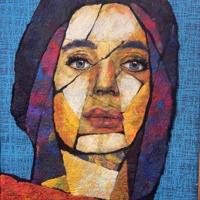
Earning “Best in Show” honors is a stunning fiber painting by Michelle Moats. A woman’s face has been felted back together from broken pieces, reminding us of how fragile we are.
“This fiber portrait was created in many steps,” she said. “I completed multiple stages of wet felting to create the fabric of her face and then felted the pieces together. Her beauty emerged fully when I painted her facial features through the process of needle felting.” Resembling a face pieced together like a puzzle, the fragments blend to create a beautiful, yet complex portrait.
“Construction” by John Guarnera is a stoneware thrown and hand-built form sprayed with Shino glaze with carbon trap. This ceramic creation seems to remind us that a single process may not always be the way to create. It appears that the thrown piece did not become successful until it was added onto, through hand-building and finally given an earthy glaze. Textures were added to the surface as were details like a small bird before it was completed with a top narrow spout. It appears to remind us to keep adding and trying new things to heal imperfections and find the beauty in the broken.
Julia Briggs, of Cleveland, Ohio, brought her mixed media sculpture “Priceless” to the exhibition. Here a woman appears to be breaking apart, perhaps due to the turmoil within. Yet, in a nod to the Japanese art of repairing pottery, the sculpture is mended with gold, making the imperfections more pronounced yet stronger than before. It is said to be a metaphor for embracing one’s flaws.
Briggs states, “My artwork expresses the dignity within emotionality and is unafraid to show the depth of its feelings. By valuing transparency, I want to show the strength in sensitivity and utilize emotionality as a tool towards seeking understanding on a common ground.”
Sarah Nguyen is a multimedia artist, usually working primarily with paper. In “Kris – In Memoriam” she has created a golden Bobbin lace, which is a complex, yet delicate lace textile made by braiding and twisting lengths of thread. In this sculpture, the lace piece dangles from overhead, and as it reaches the pedestal, it appears to be unraveling. Its message examines the concepts of loss, grief and the impermanence of our human existence. This piece was inspired by a friend of the artist who, “did so much in such a small amount of time.”
The acrylic painting, “Cutting Ties” by Katrina Macias of San Antonio, Texas, shows a pair of sisters facing in opposite directions with long dark hair that appears to attach the girls together; each holds a pair of scissors. For the artist, the idea of “Cutting Ties” came from the realization that “families we were born into were never meant to be permanent. You only have 18 years with your siblings before you have to move on with your life and leave them behind.” Neither girl seems to want to separate yet, though they know they must. It is a bittersweet scene about moving on and growing up.
“Beautifully Broken” is a chance to connect with others through the representations of our common imperfections. It is a reminder that there is value in recognizing and accepting our “broken-ness,” which does not necessarily equate to weakness but provides an opportunity to acknowledge our own flaws and to help one another through their own. Through the variety of art represented in this exhibition, we are reminded not to deny being less than perfect; for it is in those details that one finds their uniqueness and from that, strength.
“Beautifully Broken” is on view at CALC until Feb. 4. Gallery hours are 10 a.m. to 5 p.m. Tuesday to Friday, 10 a.m. to 3 p.m. Saturdays, or by appointment. CALC is located at 38 W. Pomfret St., in Carlisle. The exhibition is free and open to the public. Visit www.CarlisleArts.org or call 717-249-6973.
For the first time in 300 years, Rembrandt’s famed “The Night Watch” is back on display, with missing parts temporarily restored in an exhibition aided by artificial intelligence.
Joseph George holds a degree in history and art history from Dickinson College. He and his wife, Barrie Ann have spent over 30 years together traveling and visiting art galleries locally and throughout the world. They have been writing about the art scene, both locally and internationally, for ten years. Their tastes range from fine art to street art.
Credit: Source link


