


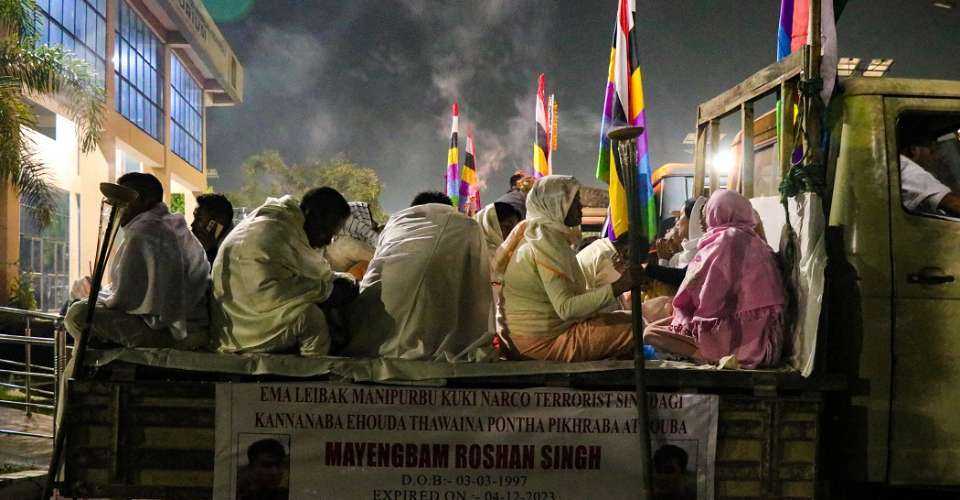
The High Court in India’s northeastern Manipur state on Feb. 22 deleted a paragraph from a controversial order that reportedly resulted in unprecedented ethnic riots in the state, killing some 175 people mostly Christians.
The Manipur State High Court deleted part of the March 2023 order that directed the state government to send a recommendation on ‘Scheduled Tribe’ status for the Hindu Meitei community, which triggered protests from the Christian majority Kuki tribal people.
The ethnic violence that began in May 2023 killed at least 175 people and injured some 1,100. Some 30 people are also reported missing. The rioters burned down or vandalized some 380 religious structures including temples and churches, according to reports.

The violence between Meitei Hindus and Kukis and Zos (Christians) also left more than 70,000 people displaced.
A panel of experts appointed by the UN Human Rights Council, who did not speak on behalf of the United Nations, said they were especially concerned “that the violence seems to have been preceded and incited by hateful and inflammatory speech.”
“The March 2023 High Court ruling was bad in law. It entitled Hindu Meiteis to the same economic benefits and quotas in government jobs and education as the minority Christian Kukis. Finally, after a review petition was filed, the impugned order has been set right,” says analyst Ashutosh Talukdar.
The court move “may help bring normalcy in violence-hit Manipur state,” he added.
According to the 2011 census, Manipur is 41.29 percent Christian, mostly tribal people, while 41.39 percent are Hindus.
The Christian Kuki people oppose granting tribal status to Hindu Meitei people. Tribal status will enable Hindus to access special governmental concessions meant to bring weaker tribal people into the social mainstream.
The pro-Hindu Bharatiya Janata Party (BJP) government in Manipur led by Chief Minister N Biren Singh allegedly allowed taking legal measures to help Hindus. The tribal status will also enable Hindus buy tribal lands in the hills, where the Kukis predominately live.
The Kuki tribal Christians opposed the court order fearing that it will lead to Hindus eating into their share of land, jobs and other opportunities.
The BJP, which also runs the federal government led by Prime Minister Narendra Modi, was “accused of pursuing policies that discriminated against Christian Zos, Paiteis and Kukis, including forced evictions that threatened the security of their land. There was an attempt to cast us as illegal immigrants,” said a Kuki lawmaker in Manipur.
Modi’s trusted home minister, Amit Shah, rejected outright the demand to replace Chief Minister Biren Singh in Manipur and also announced in early February that the federal government will establish a fence along India’s 1,624-kilometer border with Myanmar that runs through Manipur, Mizoram, Nagaland and Arunachal Pradesh.
Shah’s announcement has also been strongly opposed by Nagas and Mizos, who are predominantly Christian and share ethnic bonds with brethren in Myanmar.
The tension is far from over. Intermittent clashes continue in Manipur.
Since the violence broke out, some 18,000 Internally Displaced People have taken shelter in 115 relief camps. The relief camps across violence-hit Churachandpur are looked after by more than a dozen civil society organizations.
Last year, the Supreme Court Chief Justice reprimanded the government for not bringing the situation in Manipur under control.
“It’s time that the government steps in and takes action because this is simply unacceptable,” he said.
Shah visited Manipur at the end of May last year, but the visit failed to bring normalcy as the “peace committee” set up by Shah has been shunned by Kuki groups.
In many cases, police have been accused of refusing to assist Kuki people, who have been attacked. Several cases of violence against Kuki are also not investigated, Kuki leaders say.
Credit: Source link


