


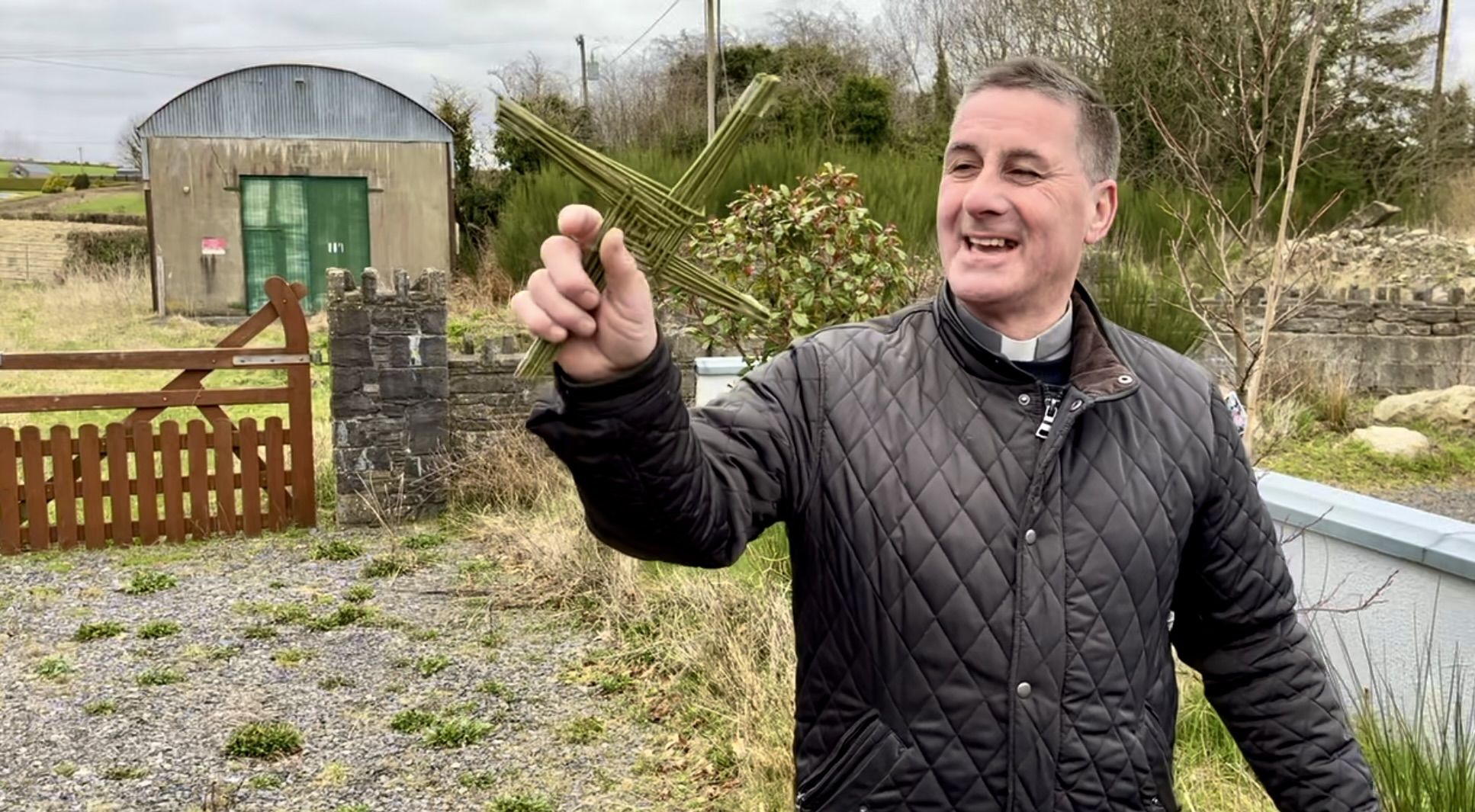
Anglican Rev. Canon Alison Joyce from London will deliver the sermon at the ecumenical service.
The service will be followed by a “pause for peace,” a minute of silent prayer for peace. St. Brigid was known as a peacemaker. Among the many stories told about St. Brigid, local tradition holds that Brigid gave away her father’s sword in exchange for food for a family suffering from hunger.
The fifth-century abbess St. Brigid is one of Ireland’s three patron saints, along with St. Patrick and St. Columba. Most historians place her birth around the year 450, near the end of St. Patrick’s evangelistic mission.
It is notoriously hard to establish the historical details of Brigid’s life, but according to one of the more credible biographies of Brigid — Hugh de Blacam’s essay in “The Saints of Ireland” — Brigid was born out of wedlock to a pagan chieftain named Dubthach and a Christian slave woman named Broicsech. The chieftain sold the child’s pregnant mother to a new master but contracted for Brigid to be returned to him eventually.
Brigid was likely baptized as an infant and raised as a Catholic by her mother. Thus, she was well formed in the faith before leaving Broicsech’s slave quarters at around age 10 to live with Dubthach and his wife.
After this, Brigid’s faith grew immensely. She gave generously to the poor and tended to the sick. One story says Brigid once gave away her mother’s entire store of butter, which was later replenished after Brigid prayed.
Once she was released from servitude, she was expected to marry. However, Brigid had no interest in marrying. She went so far as to disfigure her own face and prayed that her beauty be taken from her so no one would want to marry her. Because she refused to change her mind about marriage, she received permission to enter religious life.
Brigid, along with seven friends, is credited with organizing communal consecrated religious life for women in Ireland.
In 480, Brigid founded her monastery in Kildare, which was called “Church of the Oak.” The monastery sat on top of a shrine to a Celtic goddess. Throughout the rest of her life, she established several monasteries across Ireland.
Brigid rooted her life as a nun in prayer, but she also performed substantial manual labor: cloth making, dairy farming, and raising sheep. She also spent time traveling across Ireland founding new houses and building up a uniquely Irish form of monasticism. When she was not traveling, pilgrims made their way to Kildare, seeking the advice of the abbess.
(Story continues below)
Subscribe to our daily newsletter
“What were the character traits that defined St. Brigid of Kildare? To mention just a few, she was hospitable, she was a peacemaker, she was a strong woman of faith,” Nulty said.

Courtney Mares is a Rome Correspondent for Catholic News Agency. A graduate of Harvard University, she has reported from news bureaus on three continents and was awarded the Gardner Fellowship for her work with North Korean refugees.
Credit: Source link


