


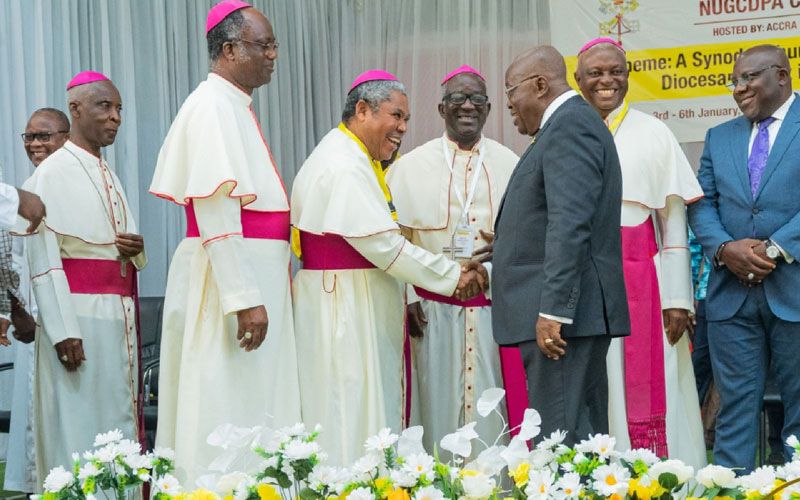
“The strong resistance to the debt restructuring from domestic resources to meet the IMF bailout conditions is a natural response from those directly or indirectly affected,” they say, adding that the options for the government to resolve the economic crisis “appear limited”.
“We, therefore, hold the position that, given the issues that have arisen with government’s resort to an IMF bailout, and the mistrust it has garnered, does not make the domestic debt restructuring option appear viable,” they say in the statement signed by GCBC President, Archbishop Matthew Gyamfi of Sunyani Archdiocese.
As a way forward, GCBC members say the government “should involve all stakeholders, particularly individual and financial institutions directly affected, and carry them along in addressing the problem.”
They also call on the government to “vigorously pursue some debt forgiveness and/or deferment, where feasible so that if at all, the domestic debt restructuring burden could be reduced drastically and its impact on stakeholders minimized.”
To win the international community over in pursuit of the IMF bailout, GCBC members say, “Government must present a posture that is consistent with the fact that the country is in dire straits or crisis.
Some of the issues that could be presented include drastic government expenditure control by reducing the number of government appointees; suspending non-essential projects; and a review of the free Senior High School (SHS) policy, Catholic Bishops in Ghana say.
While they expect the government to consider their suggestions, they say, “We humbly appeal to Ghanaians to appreciate the current economic situation and understand that there will be difficulties in the coming months while the problem is solved permanently.”
GCBC members say they believe that there will be goodwill, transparency, and commitment to the common good in the debt restructuring process.
Magdalene Kahiu is a Kenyan journalist with passion in Church communication. She holds a Degree in Social Communications from the Catholic University of Eastern Africa (CUEA). Currently, she works as a journalist for ACI Africa.
Credit: Source link


