


As a Seattle-based conceptual artist, Marin has tasked herself with elevating and highlighting the varied and complex answers she gets from the Black creatives she invites into conversation.
“I think that I wanted to be a star, and then it was lonely. So I was like: ‘it sucks on earth but at least there are people there.’ So I decided to be born again,” Amber Flame answers. “I turn 36 this year. I did not know that I could heal myself,” Salma Siddick responds. “I imagine an Africa where we don’t feel bad for speaking our native tongue. Where English, French, Dutch is not the standard,” Nii Okaidja notes. “I breathe the oxygen of my ancestors, and I walk with pride so strong the earth quakes under my feet,” Julia Ismael says.
These are a handful among dozens of testimonies in a new virtual exhibition and online experience that Marin has curated: “Sites of Power.” Launching this week, it’s the fifth chapter in Marin’s Black Imagination series, a yearslong series of art experiences centering Black stories, Black complexity and Black joy.
The “Sites of Power” website features more than five-dozen song-length audio files (organized in playlists, one per question) from interviews with more than 20 Black artists, writers, chefs, consultants, doctoral students, poets, professors, photographers and dancers — most of them Seattle-based. (Locals may recognize writer/performer Amber Flame, chef Tarik Abdullah, writer Charles Mudede and LANGSTON executive director Tim Lennon.)
“I encourage people to visit the site, find a playlist, turn off the lights, close their eyes and just listen,” Marin says.
What you’ll hear: Laughter. A sigh. Hesitation and assertion. Stories about the importance of naps, feeling loved and karaoke. The complexities of crying as a Zimbabwean man. Vivid descriptions of eating ugali (a type of maize flour porridge made in various African countries). People tracing their bloodlines back to California, Nairobi, Pakistan, Ghana and Masvingo.
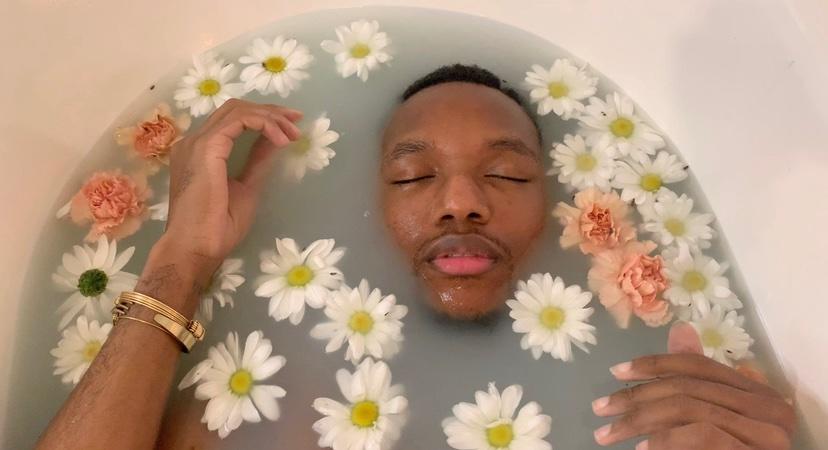
While the aural experience is a crucial part of the project, “Sites of Power” features strong visual elements, including paintings by Marin — swirling blue-toned whirlpools she describes as “portals to the Black imagination.” It also presents a series of confessional-style videos in which interviewees speak directly into a camera (recorded in collaboration with Seattle-based film production company Cut), as well as eight short poetic videos directed by the Seattle-based director, educator and performer Jay O’Leary Woods. During Black History Month, various collaborating community organizations like 4Culture and LANGSTON will share the videos on their platforms as well. (“Sites of Power” will stay up online indefinitely.)
Originally, these video and audio testimonies were meant to be shown on large screens, as part of a sweeping “Sites of Power” exhibition at Seattle’s Northwest African American Museum, which was slated for an April 2020 premiere. After the pandemic struck down the show, Marin decided to make the work digitally accessible as a literal (web)site of power (she notes that each video is a site of power in itself).
It was a “classic lemons-to-lemonade situation,” Marin says. “Of course there’s a lot of grief around planning towards and expecting to put on a physical exhibition … but there’s also been a lot of beauty and joy that comes from meeting the challenges of people-centered work in a pandemic.”
Marin, who is 41, likes to say that her medium as a conceptual artist is people — the same way “a painter may work with a paint and a sculptor may use marble or steel,” she told Crosscut in 2019. Whether she makes use of paint, poetry, physical objects or audio and video, her artwork is always participatory. Marin is the artistic equivalent of your extrovert friend who will invite a bunch of strangers to a party: the more (Black people, specifically) the merrier.
That’s very much the case for Black Imagination. Marin started the project in 2017 by asking Black people to respond to three online questions and prompts: “What is your origin story?” ”How do you heal yourself?” and “Describe or imagine a world where you are loved, safe and valued.”
Credit: Source link


